
You breathe about 20,000 times a day, mostly without noticing. Yet your breath is unusual: it’s one of the few automatic functions you can also guide on purpose. You can’t tell your heart to slow down, but you can lengthen an exhale.
That’s what makes mindful breathing for nervous system regulation so powerful. It needs no equipment or flexibility, just a few moments of attention. In this guide, you’ll learn why breath shapes how you feel, how to practice in a gentle, trauma-informed way, and five simple techniques you can use anywhere.
Why Your Breath Is a Doorway to Your Nervous System
Your breath runs on autopilot, but it also listens. The moment you pay attention to it, it starts to change. That two-way relationship makes the breath a natural doorway into your nervous system.
Here's a simple example. As you inhale, your heart rate rises slightly. As you exhale, it slows. This gentle rhythm is called respiratory sinus arrhythmia, and it's a normal sign of a healthy, flexible nervous system. It also explains why a long, unhurried exhale feels so calming: you're spending more time in the part of the breath that tells your body it can soften.
Researchers have studied slow breathing closely, usually defined as fewer than 10 breaths a minute. A 2018 systematic review linked it with higher heart rate variability, a marker of nervous system flexibility. People in the reviewed studies also reported feeling more relaxed and alert, with fewer symptoms of anxiety and tension.
When stress keeps your body braced, your breath often becomes quick and shallow. (We describe this stuck-in-overdrive pattern on our somatic yoga therapy in Chicago page.) Gently changing the breath sends a different message back to your body: you're safe enough to settle.
Mindful Breathing vs. Breathwork: What's the Difference?
People often use "mindful breathing" and "breathwork" as if they mean the same thing. They're related, but they aren't identical.
Mindful breathing, also called breath awareness meditation, means noticing your breath exactly as it is. You aren't trying to fix or improve it. You simply feel where it moves, how fast it goes and how it changes on its own.
Breathwork means gently shaping the breath, for example by slowing it down or making the exhale longer than the inhale.
Both have value. In a 2023 randomized controlled trial from Stanford, participants spent five minutes a day for a month on either mindfulness meditation or one of three breathing exercises. Every group felt better and less anxious. Breathwork lifted mood more than meditation did, and an exhale-focused technique called cyclic sighing produced the biggest improvement of all.
In SomaYoga, we use both, in a particular order: notice first, then shape. Awareness helps you meet your body where it is today. Gentle shaping then offers your nervous system a new option, rather than forcing a change it isn't ready for.
A Trauma-Informed Approach: Why Gentle Matters
Many breathing guides leave this out: for some people, focusing on the breath doesn't feel calming at first. It can feel uncomfortable, unfamiliar or even a little alarming. If that happens to you, nothing is wrong with you. It's especially common for people who have lived with anxiety, panic or trauma, where the breath has become tied to feeling unsafe.
A trauma-informed approach means you stay in charge. These options can help breath practice feel safer:
Keep your eyes open, with a soft gaze resting on the floor or a spot in the room.
Start small. One or two minutes is a complete practice.
Choose a different anchor. If the breath feels like too much, rest your attention on your feet on the floor, your hands in your lap or the sounds around you.
Stop anytime. Pausing is part of the practice, not a failure.
You'll notice this guide leaves out forceful styles such as long breath holds or rapid, heavy breathing. Those techniques have their place. But for a nervous system that already feels overwhelmed, they can add intensity instead of ease.
If you notice dizziness, tingling in your hands or face, a racing heart, or a spaced-out, faraway feeling, pause and let your breath return to its natural rhythm.
5 Gentle Breathing Practices to Try
Each of these practices is gentle enough for beginners. Try them seated or lying down, in whatever position feels most supported. Breathe in through your nose if that's comfortable, and never push past what feels okay.
1. Natural Breath Awareness
This is the foundation for every other practice. You aren't changing anything, just noticing.
Settle into a comfortable position and let your hands rest.
Notice where you feel your breath most clearly: your nostrils, chest, ribs or belly.
Follow a few breaths in and out without trying to make them deeper or slower.
If it helps, silently count each exhale from 1 to 10, then start again.
When your mind wanders (it will), gently return to the next breath.
Best for: starting any practice or checking in with yourself. Time: 2–5 minutes.
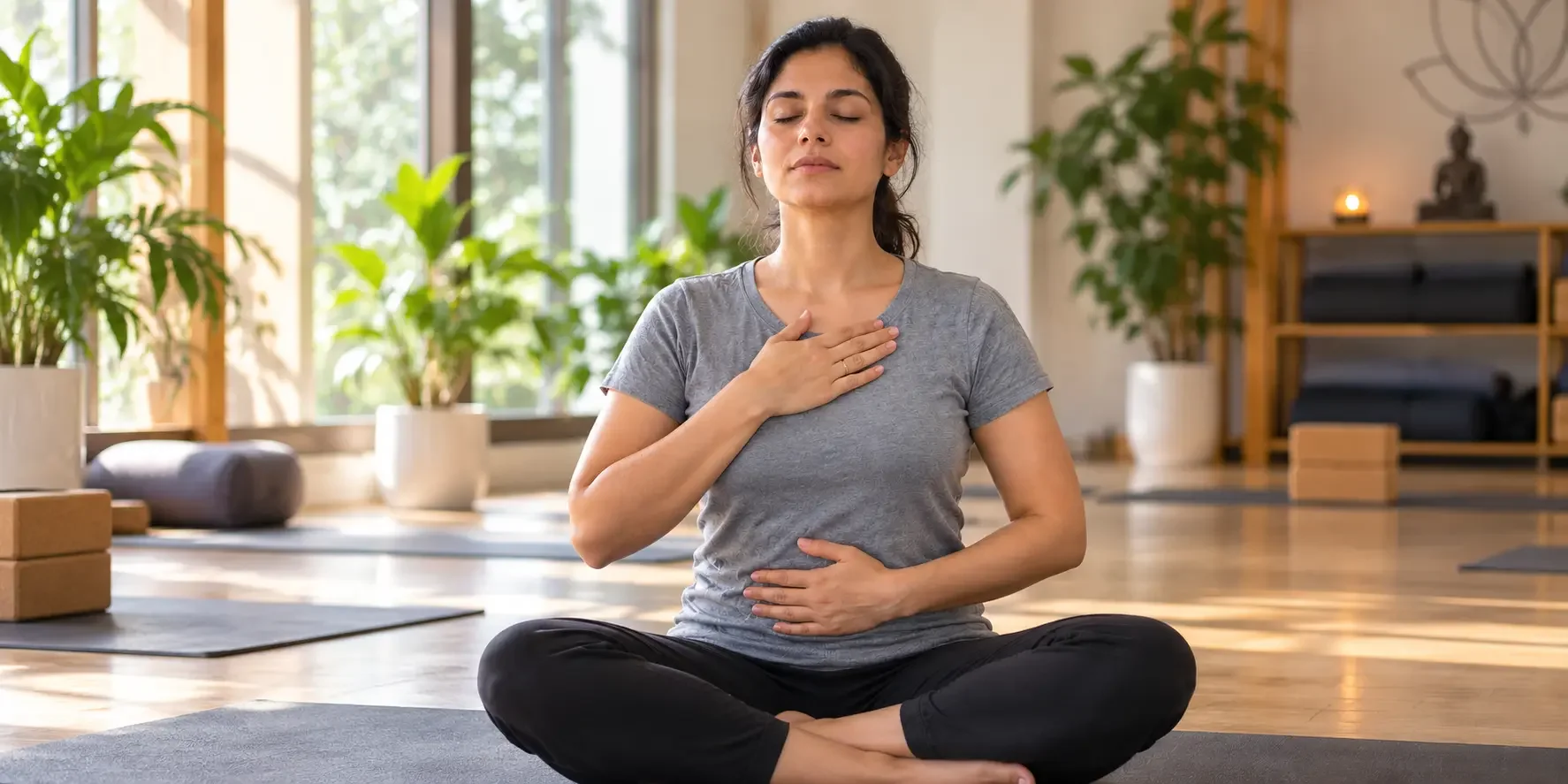
2. Diaphragmatic (Belly) Breathing
Under stress, the breath often climbs up into the chest and shoulders. Belly breathing invites it back down to the diaphragm, your main breathing muscle.
Place one hand on your chest and the other on your belly, just above the navel.
Breathe in slowly through your nose and let your lower hand rise first.
Let your upper hand stay fairly still. There's no need to push your belly out.
Exhale gently and feel your belly soften back toward your spine.
Continue for several breaths, keeping the movement easy.
Best for: softening chest and shoulder tension and breathing more fully. Time: 3–5 minutes.
3. Extended Exhale Breathing
This is one of the simplest ways to help your body settle, because it lengthens the calming phase of the breath.
Breathe in through your nose for a slow count of about 4.
Breathe out through your nose or softly pursed lips for a count of about 6.
Skip any holds at the top or bottom. Let each phase flow into the next.
If 4 and 6 feel like too much, try 3 and 4. What matters is an exhale slightly longer than the inhale, not the exact count.
Best for: winding down in the evening or easing an anxious moment. Time: 2–5 minutes.
4. The Cyclic Sigh
This is the technique that stood out in the Stanford study. It mirrors the natural sigh your body already uses to reset itself.
Inhale fully through your nose.
Take a second, shorter sip of air through your nose to top off your lungs.
Exhale slowly and completely through your mouth, making this the longest part of the breath.
Repeat at a relaxed pace. If five minutes feels long, start with a few rounds and build up.
Best for: a quick reset when you feel tense or overwhelmed. Time: 1–5 minutes.
5. Humming Breath (Gentle Bhramari)
Humming naturally lengthens your exhale, and its soft vibration gives a busy mind something soothing to rest on.
Sit comfortably, relax your jaw and keep your lips softly closed.
Breathe in through your nose.
As you exhale, make a soft, low hum, like a quiet "mmm."
Let the hum last as long as feels easy, then breathe in again.
After a few rounds, pause and notice any buzzing or softness in your face, throat and chest.
Best for: quieting mental chatter. Many people also notice their jaw and face soften. Time: 2–3 minutes.
What about box breathing? It uses equal counts to inhale, hold, exhale and hold. It works well for some people, but the holds can feel tense for others, so it isn't on this list. See the FAQ below for a gentler way to try it.
A 10-Minute Mindful Breathing Meditation
This short meditation weaves the practices above into one gentle sequence, with your breath as the anchor the whole way through. Read it through first, or record yourself reading it slowly and play it back.
Arrive (1 minute). Find a position where your body feels supported: seated with your feet on the floor, or lying down with a pillow under your knees. Close your eyes, or keep them open with a soft gaze. Notice where the chair, floor or bed is holding you.
Notice (3 minutes). Bring your attention to your breath as it is right now. Feel it moving in and out. You don't need to change anything. If your mind wanders, simply come back to the next breath.
Soften (3 minutes). Let your exhale grow a little longer than your inhale, perhaps in for 4 and out for 5 or 6. Let each exhale feel like a small letting go.
Rest (2 minutes). Stop guiding the breath. Let your body breathe itself, and notice what has shifted. Maybe your shoulders have dropped, or your breath has slowed on its own.
Return (1 minute). If your eyes were closed, open them. Look slowly around the room and notice a few sounds. Wiggle your fingers and toes before you move on with your day.
If you'd like to go deeper, follow this meditation with our guided deep relaxation practice. It's a body scan that pairs beautifully with breath awareness.
Bringing Mindful Breathing Into Everyday Life
The real power of the breath is that it's always with you. You don't need a mat or a quiet room, just a moment of attention. A few places to try it:
When you wake up. Before reaching for your phone, take five natural breaths and notice how your body feels.
At a red light. Keep your eyes open and on the road, and simply notice one or two breaths. No techniques needed.
Before a hard conversation. Two or three cyclic sighs can help you walk in feeling steadier.
After a walk or workout. A few minutes of belly breathing can help your body shift toward recovery.
In bed at night. Extended exhale breathing or humming can help your body settle toward sleep.
The easiest way to build the habit is to attach it to something you already do every day, like your morning coffee or brushing your teeth. A few mindful breaths, repeated daily, add up. (For workplaces that want to learn these tools together, we also offer breathwork sessions for teams.)
Common Mistakes (and Gentler Alternatives)
Breathing practice is simple, but a few habits can make it feel harder than it needs to be.
Common mistake | Try this instead
Taking huge, forced breaths | Breathe low and slow, not big
Lifting the chest and shoulders | Let your belly and lower ribs widen
Holding the breath to "do it right" | Keep the breath smooth and continuous
Judging yourself for doing it wrong | Get curious: "What do I notice?"
Expecting instant change | Short, regular practice builds over weeks
If a practice ever starts to feel like a struggle, go back to natural breath awareness. Long hours in a chair can leave the breath shallow and the ribs stiff (we explore how sitting can make breathing shallow in another post). Be patient as your body relearns a fuller, easier breath.
How Breath Fits Into SomaYoga
In SomaYoga, breath is never practiced in isolation. We pair it with slow, intentional movement and supported rest, so your body learns ease from the inside out instead of being pushed into it. The breath becomes a guide. It shows you where you're bracing, and it helps you let go.
If you're new to this approach, you can read more about what SomaYoga is. And if you'd like personal guidance, private SomaYoga therapy sessions are tailored to your body, your stress patterns and your pace.
Frequently Asked Questions
-
About five minutes a day is a great place to start. In the Stanford study, five minutes of daily practice was enough to improve mood, and the benefits grew the more days people practiced. Consistency matters more than length, so a short daily practice beats an occasional long one.
-
Box breathing (inhale, hold, exhale, hold, each for an equal count) helps some people feel focused and calm. For others, the holds create tension. If you're feeling anxious, try extended exhale breathing first. If you'd like to use box breathing, keep the holds short, around two counts, and skip them if they feel uncomfortable.
-
For most practices, breathing in through the nose is the gentlest default because it naturally slows the breath. Exhaling through the mouth is fine, and it's part of the cyclic sigh. If your nose is congested, breathe in whatever way feels comfortable.
-
This is more common than most people realize, especially for anyone with a history of anxiety, panic or trauma. Close attention to the breath can feel exposing. Try keeping your eyes open, practicing for just a minute, or moving your attention to your feet, your hands or the sounds around you. You can return to the breath when it feels more comfortable.
-
They can help your body settle at bedtime. A longer exhale and gentle humming both encourage relaxation. Try a few minutes of extended exhale breathing once you're in bed, or pair it with our guided deep relaxation practice.
-
Mindful breathing is one of the most common forms of meditation. In breath awareness meditation, you simply observe your breath. Breathwork goes a step further and actively shapes it. Both can be part of a meditation practice.
-
Gentle breathing practices suit most people. If you have asthma, COPD or a heart condition, are pregnant, or have a history of panic attacks or fainting, talk with your healthcare provider first and keep your practice gentle. Stop and return to natural breathing if you feel dizzy or unwell.
-
Your breath has been with you since your very first moment, and it will be there in every moment ahead. You don't need to master it. You only need to notice it, and over time, let it gently show you the way back to ease.
